Most of your strategies should die
June 5, 2026 · The Forven team
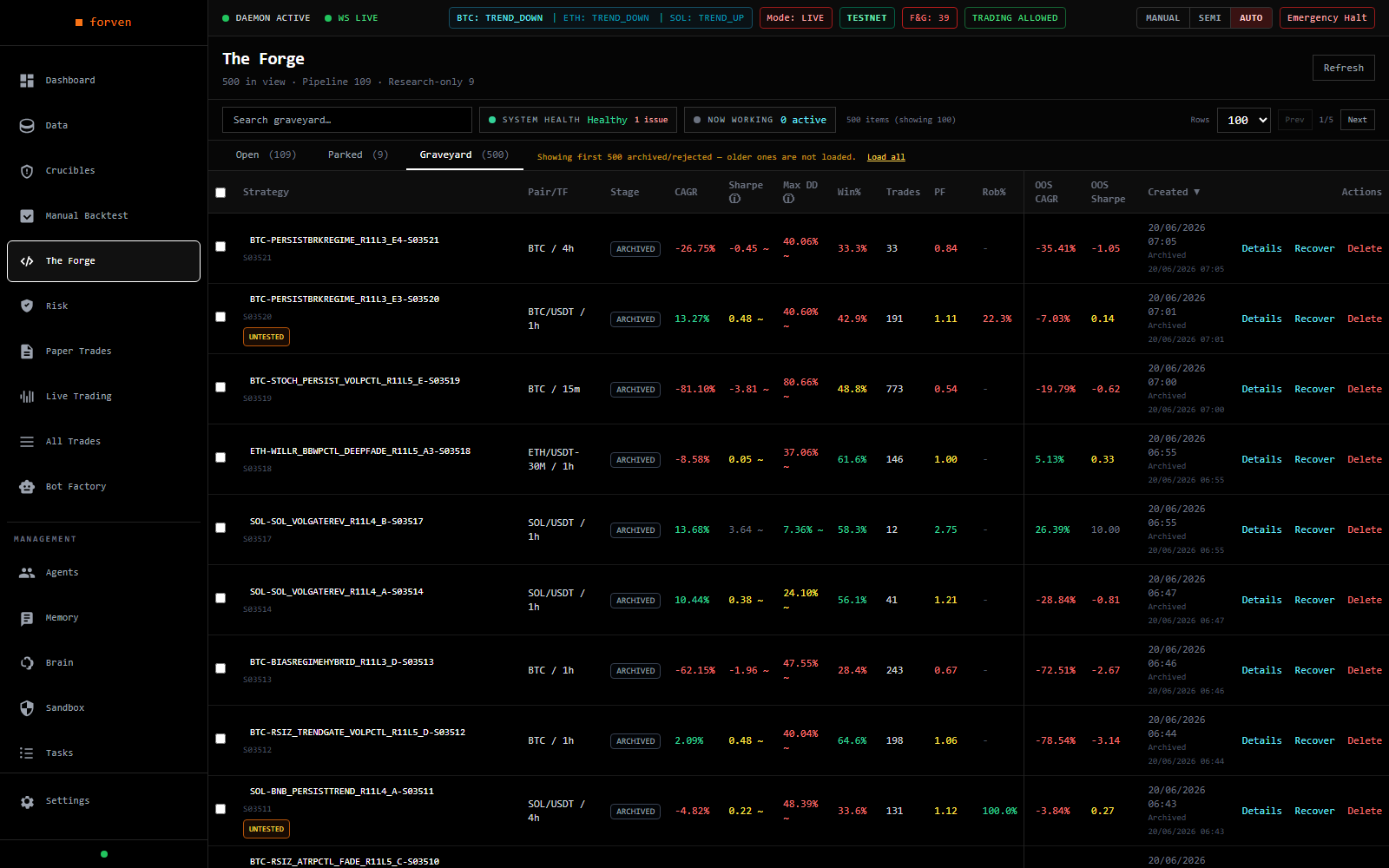
The graveyard. Every row is a strategy that died on schedule — and a healthy lab has far more of these than live ones. Illustrative research data; paper/testnet.
You will build strategies you are attached to. That attachment is the problem. The trader who survives this game kills a strategy the moment its out-of-sample edge disappears. The trader who does not gives it one more week, then another, and funds the slow bleed out of conviction.
So the central act of retail quant is not invention. It is rejection. Most of your ideas are bad, and the discipline that matters is letting them die on schedule. Forven is built to make that the default — to automate the killing so your attachment never gets a vote.
The funnel is supposed to narrow
Every strategy travels the same one-way road, and each stage exists to kill it before the next one costs more — compute, then time, then capital. Cheap tests run first so weak ideas fail fast.
Picture a hundred ideas entering at the top. (These numbers are illustrative — a shape, not a yield.) Quick-screen triage rejects curve-fit junk on basic arithmetic in roughly five minutes each: negative in-sample edge, an in-sample to out-of-sample ratio that screams overfitting, too few trades to mean anything. Say it drops half. The gauntlet — walk-forward, cost stress, Monte Carlo, regime split, parameter jitter — discards most of what is left, because surviving five years of history is easy and surviving data the parameters never saw is not. A handful reach paper. Fewer still clear the strict paper-to-live gate.
That is not waste. The narrowing is the product. A funnel that passed everything would be a charting toy with extra steps. The strategies that die paid for the few that did not, and they paid in compute instead of your capital.
The lab is not a trophy case
Reject hard enough and a new failure mode appears: the ideation loop notices what passes and mints more of it. Left alone, it will happily produce the same winning family — usually RSI momentum — until your lab is a monoculture of near-duplicates that all break on the same Tuesday.
Forven guards against that echo chamber on two fronts, both documented under evolution:
- The diversity guard watches the recent window of strategies and measures how much of it each family occupies. When one family runs too hot, the guard injects a cool-down note into the next ideation prompt — steering toward under-represented families like funding, breakout, volume, or cross-asset. It does not delete anything. It biases what gets proposed next.
- Archetype fingerprinting runs at creation time, classifying each strategy by type, regime class, indicator family, and risk profile, then rejecting redundant copies before they waste a backtest.
The diversity guard governs the mix of families. Fingerprinting blocks redundant copies inside a family. Between them, a strategy that passes every robustness test can still be rejected for the crime of being the eighth thing that looks just like the seventh. Survival is necessary. It is not sufficient.
Death does not stop at the door
The hardest darling to kill is the one that already works. A strategy can clear every gate, trade real capital, and then quietly decay when the market turns underneath it. That is when attachment is strongest and judgment is worst.
So the kill-switch does not retire when a strategy reaches live. A decay tracker watches every live strategy, and if its risk-adjusted edge falls far enough over a rolling window — with enough trades to confirm the move is real and not noise — the strategy is auto-retired. The tracker is privileged on purpose: it can retire even a strategy that protection would otherwise shield, because a degrading live strategy draining capital is the one thing protection must not block. Safety beats availability.
The retirement is not silent, either. When a strategy leaves the pipeline, Forven nudges its confidence in the patterns that produced it — down on a strategy that decayed out of live, up on one that survived. A dead strategy teaches the next generation something. The kill is the lesson, not the loss.
You can argue. It will argue back.
None of this is a cage. You can override a kill — promote a near-miss, spare a strategy the arithmetic failed. The app will let you. It will also argue, and the audit trail will remember that you insisted. The gates are arithmetic, not vibes, and the capital gates hard-code their floors so a relaxed setting can never quietly bypass them. An override is a decision you sign your name to, not a slider you nudge.
That is the whole posture. Forven does not try to confirm your conviction. It tries to disprove every idea you have, including the ones you like, and only lets the survivors through. If most of your strategies are not dying, the funnel is broken — or you are overriding it, and the log knows.
Forven is a research tool. Out-of-sample survival is evidence of robustness, never a prediction of returns, and none of this is financial advice. The point was never a machine that finds you a winner. It is a process that makes it expensive to keep a loser.
Read the philosophy if you want the rest of the argument, or clone Forven and watch your darlings die on schedule.