Bring your own keys
June 12, 2026 · The Forven team
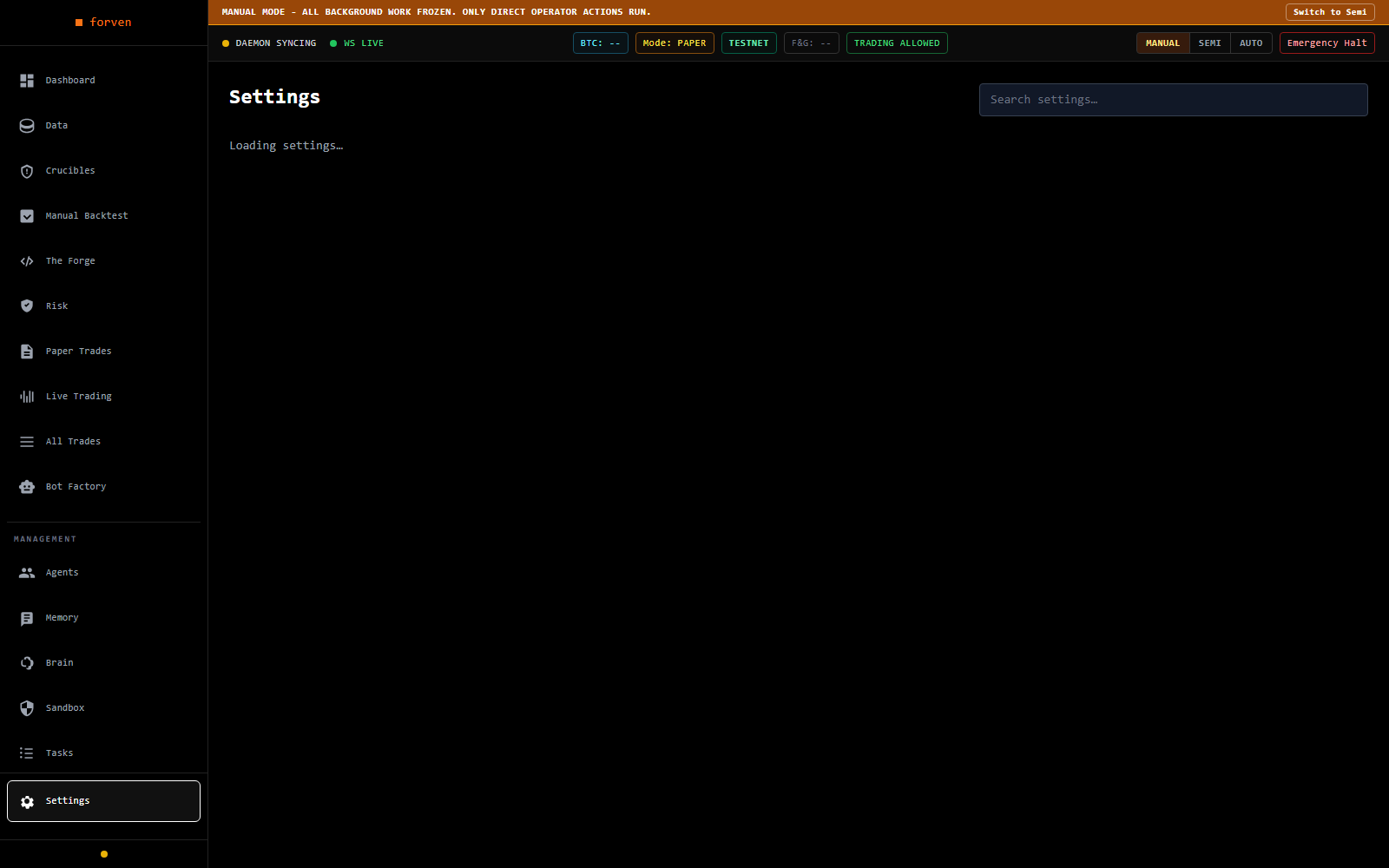
Settings live on your machine: paper-versus-live mode, your own exchange and model keys, your own configuration. Nothing here leaves the room. Illustrative; paper/testnet.
Most quant tools want your work on their servers. You upload a strategy, they run the backtest, they keep the result, and somewhere along the way your edge becomes a row in someone else's database. The good ones dress this up as convenience. The cynical ones dress it up as a leaderboard.
Forven runs the other way. The lab runs locally from source, and the work happens on your machine. Your strategies, your data, your trades, and your full research history live in one workspace directory on your disk. There is no Forven cloud doing the thinking. When we say local-first, we mean the heavy lifting never leaves the room.
What "local-first" is, concretely
It is not a slogan. It is a stack you can point at:
- A FastAPI backend that coordinates the system over
127.0.0.1. Local HTTP, no relay. - A SvelteKit frontend — the dashboard, the lab, the risk page — talking to that backend over a local socket.
- SQLite as the system of record. Every strategy, backtest, trade, and hypothesis persists in one file on your disk.
- ChromaDB as a local memory store for results and research artifacts.
All of it sits under one workspace directory. If you want to know where your research lives, it is a folder you can open. That is the whole point: nothing is held hostage in an account you can be locked out of. You can read how it works for the full tour of the pieces, but the shape is simple — a quant lab that happens to run on your hardware instead of someone else's.
Your exchange keys, your orders
When a strategy eventually earns its way to live trading, real orders route to HyperLiquid. The keys for that connection are yours. Forven reads your wallet address, API key, and secret from your environment, your encrypted settings, or a local file — and signs every order locally. There is no Forven-hosted relay standing between you and the exchange.
If you set an encryption key, those credentials are encrypted at rest in your local keystore. Either way, they stay on your device. We do not see them, store them, or proxy your orders.
This matters more than it sounds. A tool that holds your exchange keys is a tool that can place orders you did not authorize, and a single point of failure for every account wired to it. Forven is structured so that it cannot. Your keys sign your orders from your machine, full stop.
And before any of that: live execution is unsupported and heavily gated. Paper is the supported mode, and the app hard-locks execution to paper — even a correct exchange connection will not place a real order on a default install. You can test the wiring; you cannot accidentally trade with it. Paper fills against local prices and records to SQLite only. It never touches the exchange.
Your model key, never our markup
The AI layer is bring-your-own-key, and there is one promise here we will not hedge: Forven never resells model tokens, and never sees your key.
When the agent layer drafts a strategy, writes a post-mortem, or runs a deep-dive chat, those calls route through a provider chain you configure — your credentials, read locally to make the call, never shipped anywhere. The router supports a primary provider and an ordered set of fallbacks, so a transient outage at one provider hands the call to the next instead of stalling your research. You can read how that chain resolves in models and providers.
Spend is between you and your provider. Forven estimates the cost of each call locally from token counts so you can watch it, and it gives you opt-in caps to bound it — a daily agent cap and a per-thread deep-dive cap. But it does not mark the inference up, because it is not in the inference business. Those local estimates are exactly that: estimates from token counts, not your provider's invoice. Reconcile against your provider dashboard.
Free and open source, no tiers
Forven is free and open source under AGPL-3.0 — there are no plans, no paywall, and nothing to unlock.
The full local lab works with no model key at all. Backtest with an in-sample and out-of-sample split, run the gauntlet, paper-trade, and let the autonomous research daemon grind through hypotheses while you are away. The hard risk controls — position limits, the daily-loss halt, the drawdown kill-switch — are always on. That is enough to do real, disciplined research without ever talking to a model provider.
The AI agent layer — the orchestrator, the specialized agents, deep-dive chat — is the only part that needs a key, and it is your key. It is the accelerant, not the prerequisite. One honest caveat, since it bites people who expect otherwise: turning the agents on is not the same as paying for inference. The AI layer is inert without a model key. Bring a key, or run the lab without agents — either way there is nothing to buy from us.
Why we built it this way
A cloud backtester with a scoreboard is optimized for the platform, not for you. Your strategies become training data and engagement metrics; the headline numbers are tuned to look good on a screenshot. None of that makes you a better trader.
Local-first inverts the incentives. Your research is yours because it never left your machine. Your keys are yours because we never asked for them. Forven's job is to enforce the process — to refuse to let a strategy reach capital before it has earned the trip — not to harvest the output.
None of which is a promise about outcomes. Forven is a research and process tool. Any number you see in the app is illustrative, never a prediction, and nothing here is financial advice. Out-of-sample behavior can diverge from any backtest, and a strategy that survives the gauntlet survived the past, not the future.
What local-first buys you is narrower and more durable than an edge: it is custody. Of your work, your keys, and your record of what you tried and why.
When you are ready, clone and run Forven and point it at your own folder.