What Forven does while you sleep
June 20, 2026 · The Forven team
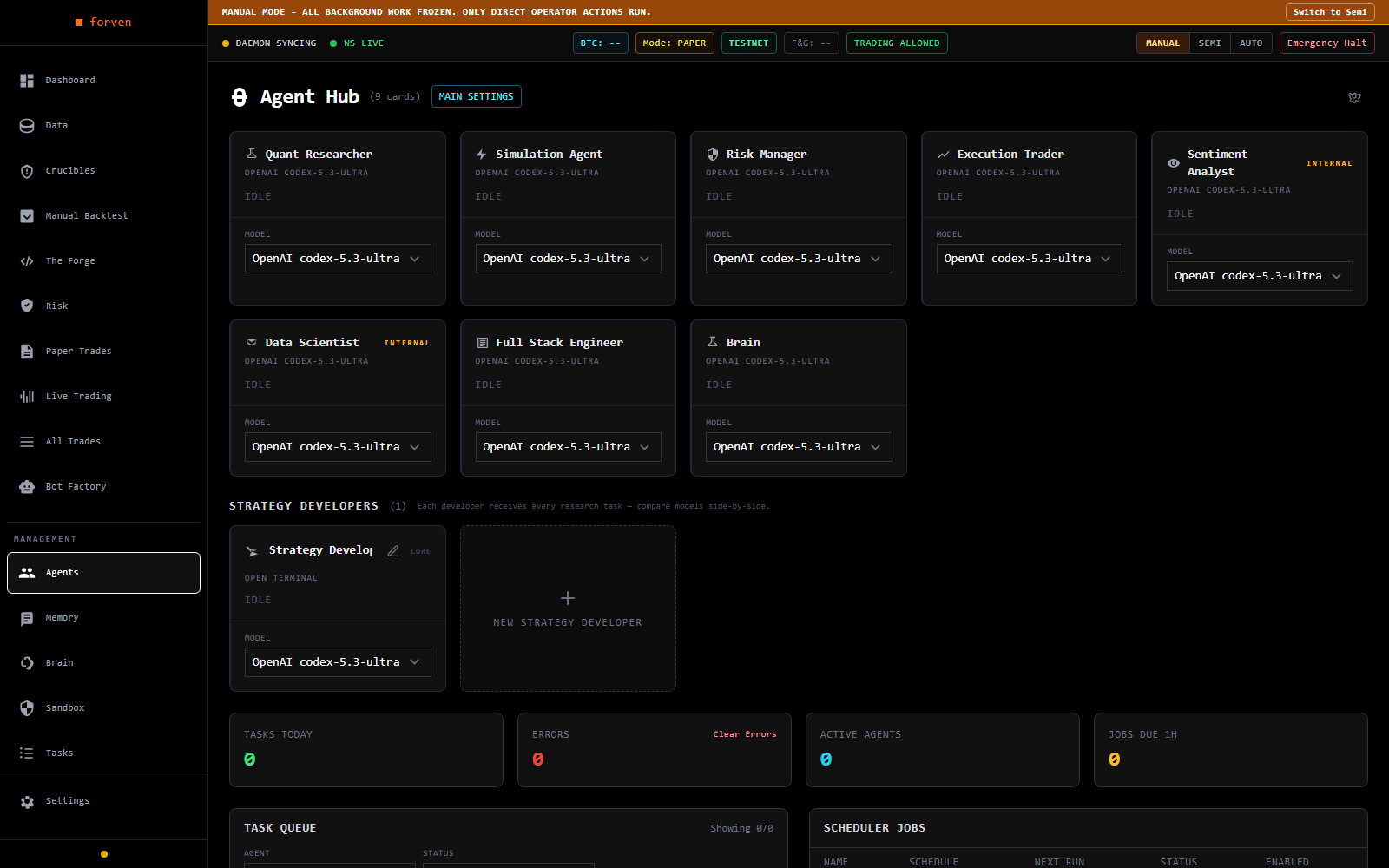
The agent hub. Each role — researcher, risk manager, execution trader, the brain, and more — runs on a model you choose. They draft, debug, and explain; they never place trades. Illustrative; paper/testnet.
The bottleneck on retail quant research is not compute and it is not data — it is your attention. You can babysit one hypothesis at a time, most of them are bad, and you find out they are bad slowly.
Forven's answer is to keep working after you close the laptop. The research daemon is the autonomous background loop. While Forven is running, it invents new strategy hypotheses, drives the candidates through the gauntlet, retires the ones that fail, and surfaces a shortlist of survivors for you to read in the morning. It is the laboratory, running overnight, on its own schedule.
It is worth being precise about that loop, because the obvious fear — software trading your account while you sleep — is exactly the thing Forven is built not to do.
The loop
The daemon runs a pipeline, not a slot machine. Each stage is a gate, and a strategy only moves forward by earning it.
- Ideation. When the active research pool runs dry, the planner mints a fresh thesis — a crucible. A crucible is a market hypothesis: indicators, regime, timeframe, target assets, and a claimed edge. Some are invented by an agent; some are harvested from external sources like a forum thread or a podcast, with every inferred field tagged so a guess never gets laundered into a fact.
- Develop. The planner spawns child strategies under the crucible and writes the code. Spawn limits and a three-strike retry cap mean a bad idea cannot churn forever.
- Screen, then gauntlet. Every candidate hits a quick screen first; the obvious failures — overfit, duplicate, too few trades — auto-archive on the spot. Survivors enter the gauntlet's robustness battery and come out the other side with a composite score.
- Retire the losers. This is the part that matters most, and it happens without you. Strategies that fail a gate, or that decay below the fitness floor or past the drawdown ceiling, are archived with a recorded reason. The default state of a candidate is dead.
- Surface the shortlist. The handful that survive everything rise to the top of the list as a shortlist, with their verdicts attached, waiting for you.
By morning you are not reading a hundred mediocre ideas. You are reading the few that refused to die overnight, and the log of why the rest did.
The brain is the only thing in charge
The daemon does not think for itself. It is a heartbeat — a set of scheduled jobs that wake things up on a cadence. The actual decisions belong to the brain, the single orchestrator at the centre of Forven.
The architecture is deliberately hub-and-spoke. The brain dispatches work to specialised agents, the agents return results to the brain, and the agents never task each other. There is exactly one place where lifecycle decisions are made and audited. That is not a stylistic choice; it is the safety property. One coordinator, one audit trail, no quiet side channels between bots.
The brain is also fail-closed. When the evidence for a promotion is missing, it rejects rather than advances. A strategy with walk-forward run but no out-of-sample result does not get the benefit of the doubt — it gets archived.
The agents are researchers, not traders
This is the line that does not move.
The agents draft hypotheses, author the Python, run the backtests, and write the post-mortems when something fails. They are co-researchers. What they cannot do is reach into your account.
- Agents never place trades directly. The execution role only emits signals; fills are gated the same way a human-authored strategy's are.
- Agents do not skip the gauntlet. No matter how confident the prose, a strategy advances only by surviving out-of-sample testing and clearing the gates.
- Every transition that consumes capital flows through an operator approval queue. The brain cannot self-approve its way to a live position — actors that are not an explicit human action are exactly the ones the gate stops.
So the worst an overnight agent can do is propose. It writes the code, runs it through the same battery your own ideas face, and queues a promotion. You wake up to a request, not a position. That distinction — researcher versus trader — is the whole design.
Keeping the bill bounded
The agent layer runs on your own model key. Forven does not resell tokens; the spend is between you and your provider. An autonomous loop that calls an LLM all night is precisely the thing that could run up a bill you did not agree to, so cost controls are part of the loop, not an afterthought.
There are two independent ceilings. The daily agent cap (agent_daily_cost_cap_usd) sums every agent task's estimated cost for the day and refuses to launch new work once you hit it — a blocked task just sits queued until tomorrow or until you raise the cap. It is opt-in and ships disabled, so if you want a budget you set one. The deep-dive per-thread cap is the second ceiling; it ships on, defaulting to an illustrative $5 per interactive thread, because a chat you are actively driving is the easiest place to accidentally loop.
The cost figures are estimates from token counts, not your provider's invoice — reconcile against the provider's own dashboard for the exact charge. The cap is the hard stop; the dollar display is the guide.
What you actually wake up to
A list. New strategies in the lab with their stages logged, an activity feed of what was planned and assigned, promotions waiting in the approvals queue for your click, and the survivors at the top of the shortlist. Backtests, verdicts, and stage transitions — research output, all of it.
None of it is a prediction. Surviving the gauntlet is not a forecast of profit, the robustness scores are illustrative process output, and nothing the daemon produces is financial advice. The point of running overnight is not to find money while you sleep. It is to spend your scarce daytime attention only on the ideas that have already earned it.
You can leave the loop off, run it semi-automatically, or unleash it fully — that is what autonomy modes are for. When you are ready to let it work, get Forven running and turn it on.