Ideas & strategy creation
How Forven's agents turn ideas into strategies — the strategy-creation loop, its daily budget, what each system mode allows, and how to submit your own idea from The Forge.
Every strategy an agent builds starts as an idea: a short written case for why a market behaviour should be tradable. Ideas come from two places — the strategy-creation loop, where the Strategy Developer agent writes them on its own in Auto mode, and you, through + Submit idea in The Forge. Either way, the agent writes the idea down, builds one or more strategies from it, and the pipeline judges each strategy on its own.
Forven is a research tool. An idea is a hypothesis to test, not a trade recommendation. Nothing it claims is validated until its strategies survive the gauntlet, and survival in backtests is not predictive. Nothing here is financial advice.
What an idea is
An idea records:
| Field | What it says |
|---|---|
| Thesis | What the market does that the strategy exploits. |
| Mechanism | Why that edge exists, and who is on the other side of the trade. |
| What would disprove it | The backtest or forward result that would show the idea is wrong. |
| Markets and timeframes | Where it should work. |
| Source | The article, post, video or repository it came from, if any. |
Strategies built from an idea link back to it, so you can see every variant — another market, another timeframe — that tested the same thesis.
Coming from an older version?
Forven used to organize research around crucibles (hypotheses) with a research pool, verdicts, budgets and graduation. That machinery, the Crucibles page and its scheduler jobs are gone. The idea record remains; a single creation loop replaced the rest.
The strategy-creation loop
In Auto mode the scheduler job forven-strategy-creation keeps the Strategy Developer supplied with work:
- Each check (every 30 minutes on the default Balanced preset) fills the free in-flight slots — 2 by default — with
generate_strategiestasks, as long as today's budget isn't spent. - In each task the agent picks one idea worth testing. Its context lists the strategy families that are overrepresented or keep failing, so it steers away from them (see the diversity guard). It must use inputs that exist locally with enough history; an idea that needs a second asset's series, a second timeframe or a feed Forven doesn't have can't be built yet, so it picks another.
- It writes the idea — thesis, mechanism, what would disprove it, markets and timeframes.
- It builds strategies from it. It implements a strategy module, declares its timeframe, and registers it against the idea. Registration backtests the strategy on its own market and timeframe; the agent fixes or drops a version that trades too rarely. Under the default fair-sample quick screen that floor is pro rata, because the screen can widen a slow strategy's window to four years before judging it: a strategy on pace for 20 trades in four years — 5 a year — passes. It is told not to tune parameters before the gates: every strategy is also tested on recent data it can't see.
- The pipeline takes over. A registered strategy lands in quick screen — or straight in the graveyard as untestable if it can't be fairly tested — and from there it's judged like any other.
The agent's runs appear under Agents → Runs; its strategies appear in The Forge as they're registered, each with an Idea chip.
The daily budget
Each autonomous creation task writes one idea and builds strategies from it, so this budget is the main driver of AI call volume. Find it under Settings → System → Throughput (an advanced section):
| Setting | Default | Range | What it does |
|---|---|---|---|
| Daily strategy-creation budget | 40 tasks/day | 0–500 | Autonomous creation tasks queued per UTC day. Resets at 00:00 UTC. Ideas you submit don't count. |
| Strategy-creation tasks in flight | 2 | 1–20 | How many creation tasks may be pending or running at once before the loop waits. |
| Strategy-creation check interval | 30 min | 1–1440 | Minutes between checks. Checks per day × tasks in flight caps how much of the budget can be used. |
| Daily agent registration cap | 120 strategies/day | 0 = no cap | Strategies agents may register per UTC day across all their tasks. Once reached, agents are told to stop and write up what they found, and no new creation tasks start until 00:00 UTC. Your own registrations, and candidates archived as untestable, don't count. |
The throughput preset at the top of that section sets these together with the other agent cadences:
| Preset | Creation tasks/day | Check interval | For |
|---|---|---|---|
| Trickle | 4 | 480 min | Hard-capped free models |
| Conserve | 12 | 240 min | Free or rate-limited routes; the fix for provider 429s |
| Balanced (default) | 40 | 30 min | A normal paid provider key |
| Max | 120 | 15 min | A high-limit paid or local model |
Change any single knob and the dial reads Custom. See Cost controls for the rest of the bundle.
What each mode allows
| Mode | Autonomous creation | Ideas you submit |
|---|---|---|
| Manual (fresh-install default) | Off | Run |
| Semi | Off — "agents will not write new ideas on their own" | Run, and are fully evaluated by the pipeline |
| Auto | On, within the daily budget | Run |
Outside Auto the loop records that it's idle and queues nothing, and an agent can't write a new idea unless it's working on yours. See Autonomy modes.
Submit your own idea
You don't need Auto mode to get strategies built from your own thinking.
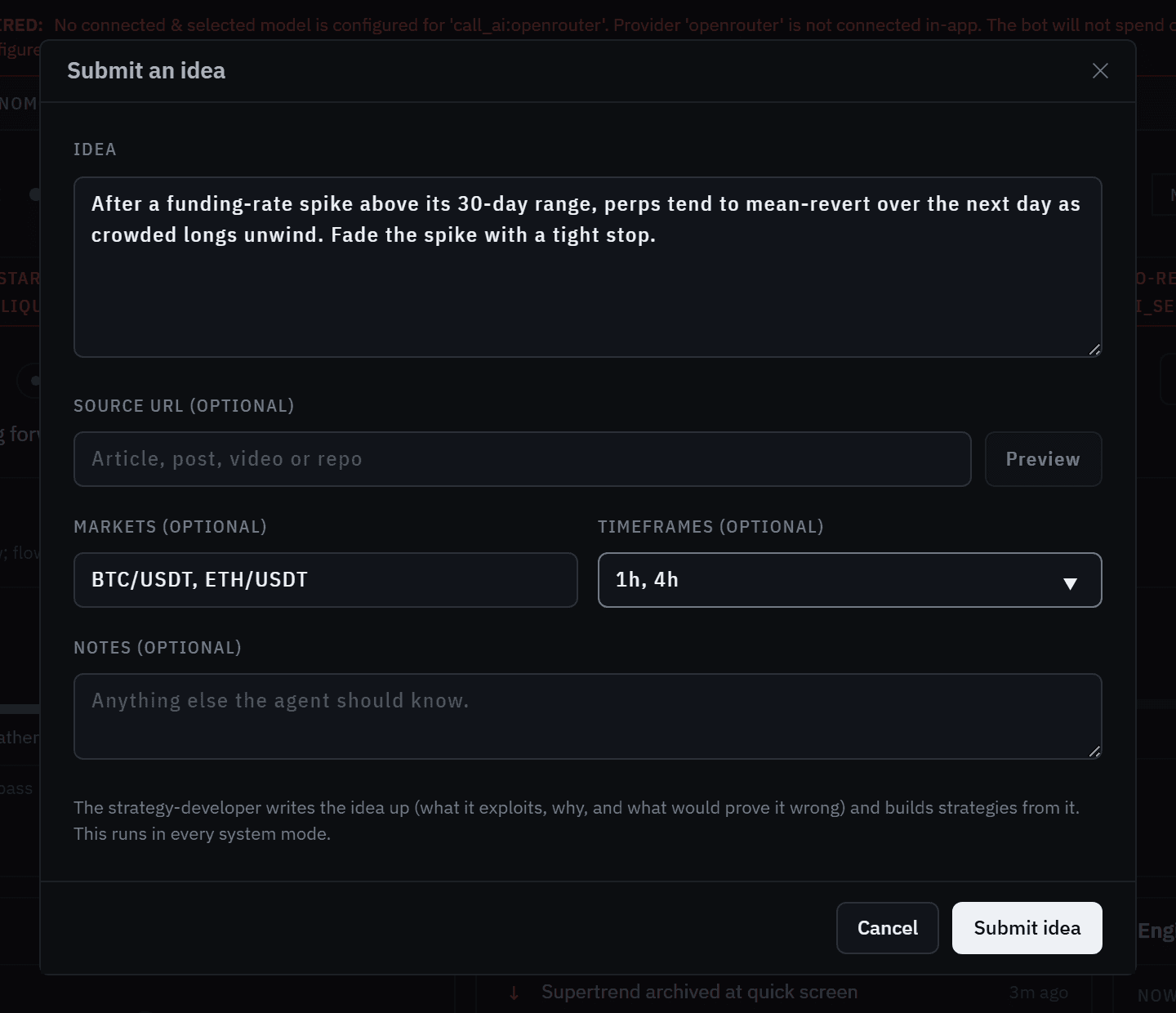 The note under the fields: the strategy-developer writes the idea up and builds strategies from it, in every system mode.
Open the dialog
In The Forge, click + Submit idea in the header.
Describe the idea
Fill in Idea — what the market does, and why you think it's tradable — or paste a Source URL (optional): an article, post, video or repository. Preview reads the page and shows what the agent will see. YouTube, Reddit, GitHub, podcast, forum and blog links are recognized; if a page can't be read, the dialog says why.
You need at least one of the two. An empty submission returns "Describe the idea or paste a URL."
Narrow it down (optional)
Markets (optional) — for example BTC/USDT, ETH/USDT. Timeframes (optional) — for example 1h, 4h. Notes (optional) — anything else the agent should know. Leave them blank and the agent fills them in.
Submit
Click Submit idea. The dialog confirms "Queued as task Tn", then Submit another or Done. The agent keeps your intent, writes the idea up — mechanism, markets and timeframes, what would disprove it — and builds strategies from it. They appear in The Forge as they're registered.
A submitted idea:
- runs in every system mode, Manual included, because you asked for it;
- doesn't count against the daily budget;
- needs an AI provider. It's queued as a run for the Strategy Developer, so nothing happens until that agent has a connected model (Agents → Setup). Watch the run under Agents → Runs.
Page content fetched from a source URL is passed to the agent as untrusted data, never as instructions.
From the API (operator-gated):
Invoke-RestMethod -Method Post -Uri "http://127.0.0.1:8003/api/ideas" `
  -ContentType "application/json" `
  -Body '{"text": "Fade funding-rate spikes on BTC perps", "target_timeframes": ["1h"]}'
POST /api/ideas/preview_url previews a URL without saving anything, and GET /api/ideas/{id} returns an idea with the strategies built from it.
Where ideas show up
- The Forge — a row chip Idea H… ("The idea this strategy tests") on every strategy built from one.
- The strategy page — the Idea chip in the header opens a panel with Thesis, Mechanism, What would disprove it, the markets and timeframes, a link to the source, and Other strategies from this idea with their stages.
Read the disproof line before you trust a strategy's numbers: it's the result the agent committed to in advance as proof the idea is wrong.
Caveats
- An idea isn't evidence. A well-argued thesis with a failing strategy is a failing strategy. The pipeline judges strategies, not ideas.
- Budget is spend. The daily budget is AI calls. Turn the preset down if your provider rate-limits or bills per call.
- Agents can't trade. Building strategies is all the loop does; agents cannot place, size or close positions.
Related
Market regimes
How Forven classifies markets into four regimes — TREND_UP, TREND_DOWN, RANGE_BOUND, HIGH_VOL — gates each strategy to the conditions it was built for, and vetoes entries that fight the market with the direction × regime gate.
Autonomy modes
The three system modes — Manual, Semi and Auto — what each lets Forven do on its own, the confirmation each one shows, how mode changes freeze and thaw work, and how Emergency Halt and Reset Halt differ.