6. Paper-trade a survivor
Watch a strategy trade forward on live market data with simulated fills — read the paper desk, follow its decisions, and open or manage a position by hand.
Paper trading is where a strategy that survived the gauntlet proves itself forward, on markets it has never seen, before any real capital is involved. Forven runs it on the live Binance feed through the same engine as the backtest, and fills every order on your machine at the live mid price. No order is sent to any exchange.
Before you start
A strategy at the Paper stage. A gauntlet survivor gets there by itself — promotion from gauntlet to paper is automatic by default, and if the paper pool (40 strategies) is full it waits in a queue for a free slot. The system mode set to Semi or Auto: in Manual, the scanner that evaluates paper strategies is paused with all other scheduled work. About 10 minutes, then days or weeks of letting it run. No exchange keys needed.
About these screenshots
To show the desk without waiting days for a gauntlet survivor, we moved a built-in SuperTrend strategy to paper by hand with the stage control's Override gate & promote — an operator escape hatch that is logged. A strategy that earns paper lands on the same desk automatically.
Open Paper Trades
Click Paper Trades in the sidebar. The status line says what this desk is — simulated fills at the live mid · no real orders · account halts don't apply to paper — when the scanner last ran, and whether prices are streaming.
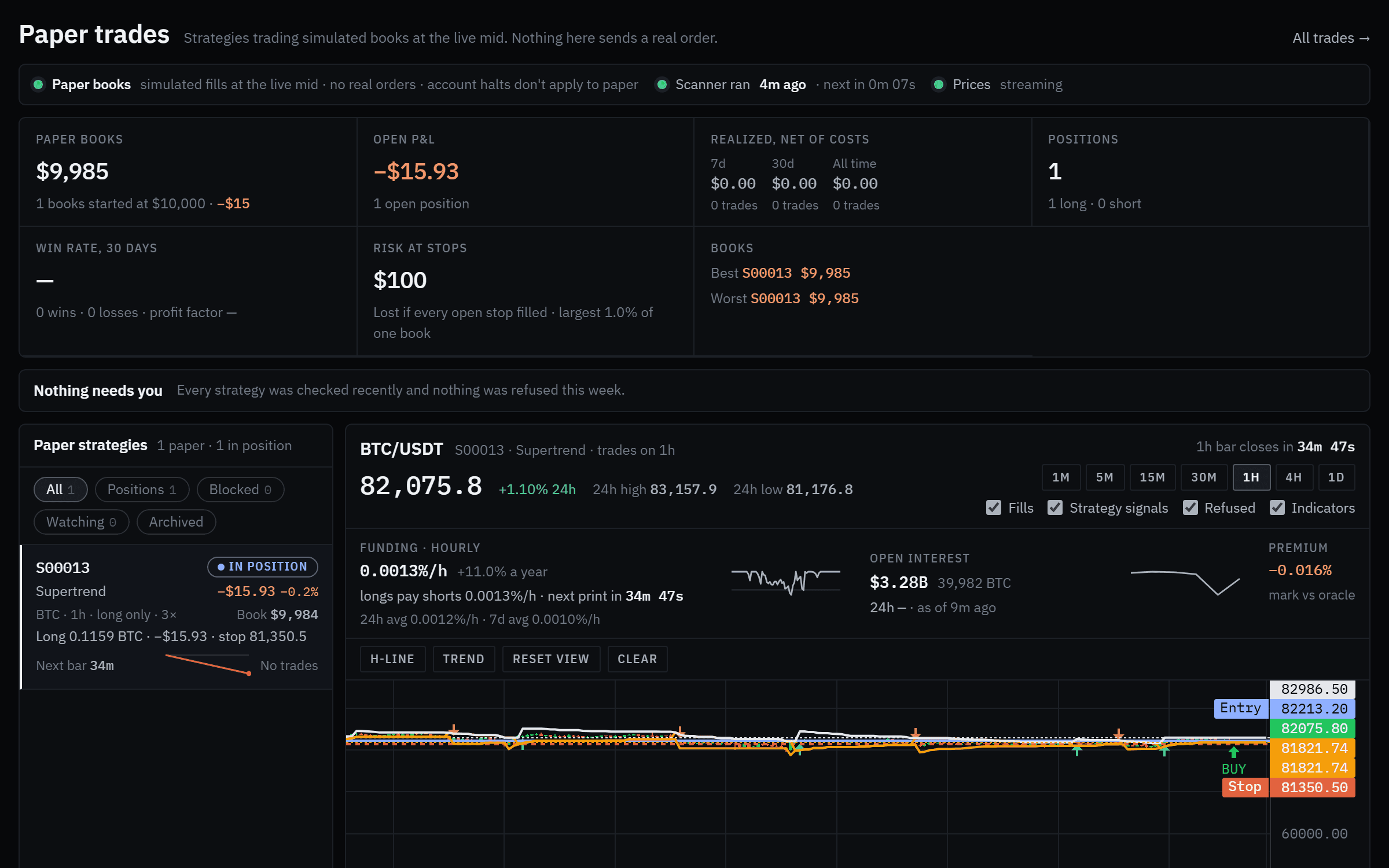 Each paper strategy trades its own $10,000 book.
Across the top, the account strip totals the paper books: open P&L, realized P&L after costs over 7 days, 30 days and all time, positions, win rate and risk at stops. On the left, the Paper strategies rail lists every strategy on paper with its state — Watching, In position, Blocked, Stale — its result so far, and when its next bar closes.
Follow one strategy
Click a strategy in the rail. The chart shows its market with every fill, the strategy's own signals, and any refused entries marked on the bars. Above it, the market strip shows funding, open interest and the premium.
The panel on the right has four tabs (keys 1–4):
- Position — what it holds now, or Flat · no paper position and what it's watching for.
- Why — in plain words, why it did or didn't act on the last bar.
- Performance — its forward results against what the backtest said it would do.
- Details — market, leverage, parameters and execution profile, and a link back to its Forge page.
The blotter at the bottom keeps Positions, Levels (stops and targets being watched), Fills, Decisions, Performance and Risk — for this strategy or all paper books.
Open a position by hand (optional)
A strategy manages its own entries and exits, but you can step in. In Position, the Manual order ticket — marked Paper · simulated — takes a direction, a size (by risk, by dollars or by coin), an optional stop and target, and leverage. A suggested stop at 2× ATR is one click away.
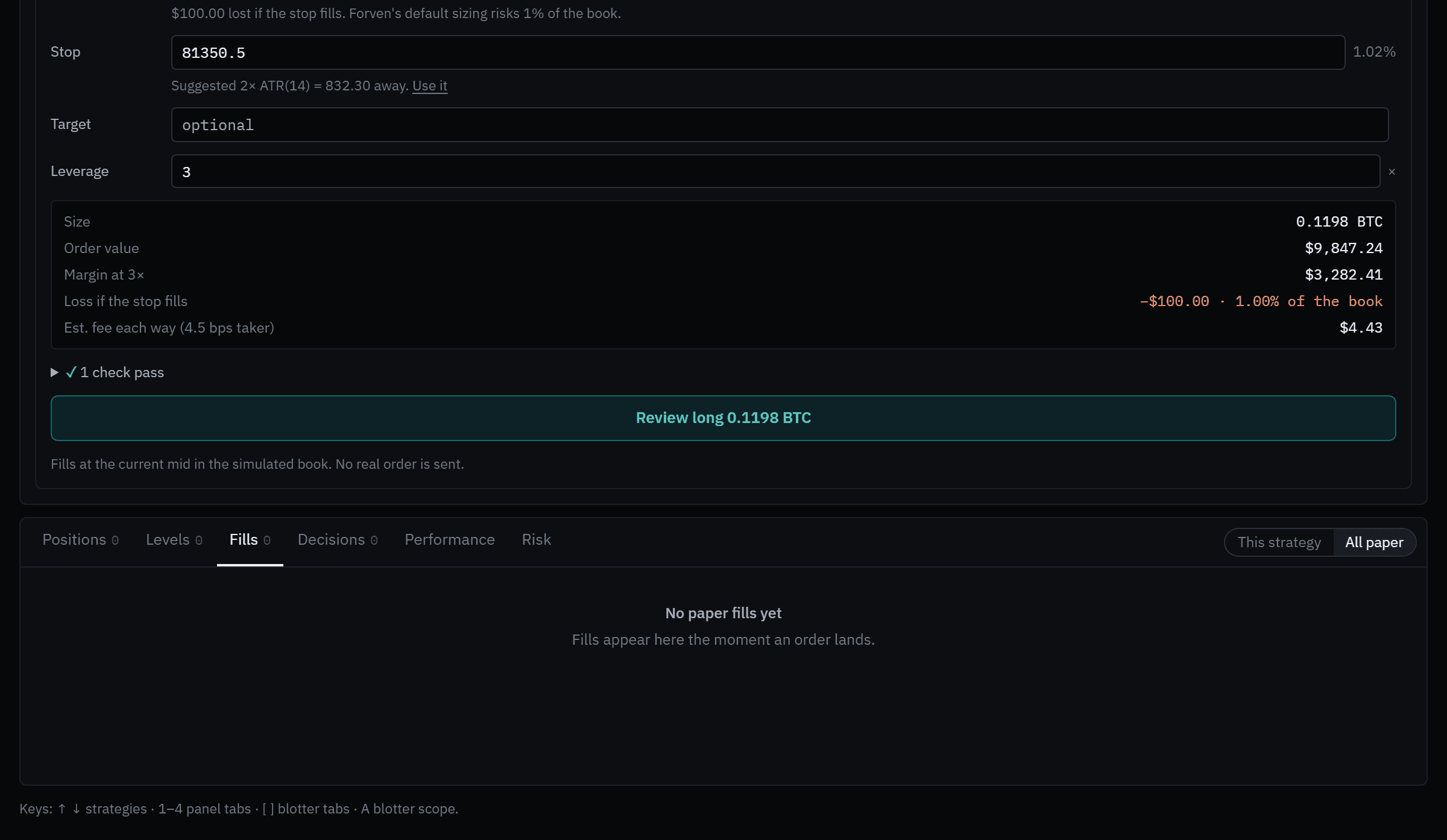 The ticket shows the loss if the stop fills before you commit.
Click Review long …. The confirmation spells out the strategy, size, stop and what will happen — then Open paper long.
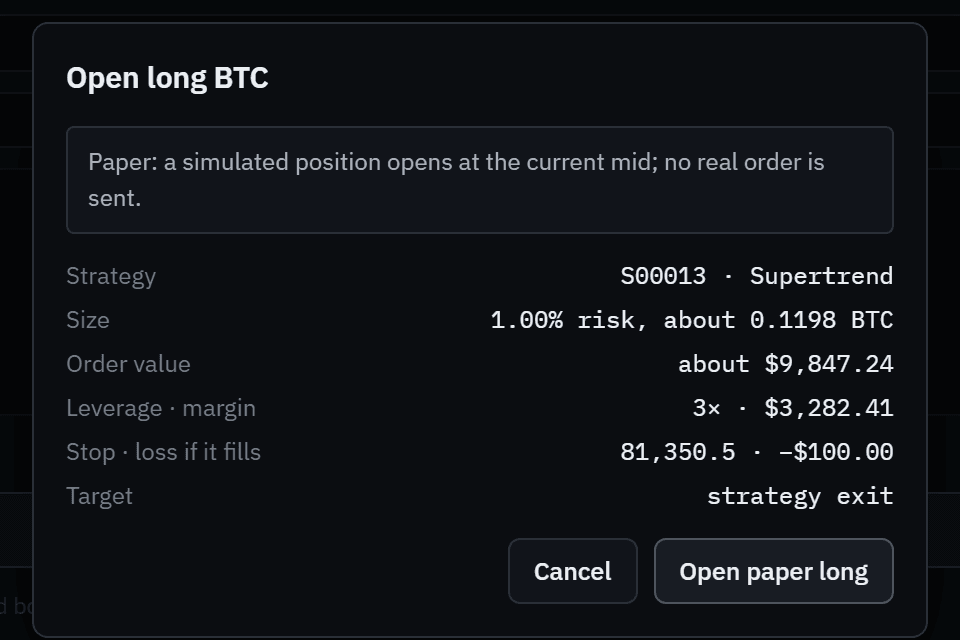 Paper: a simulated position opens at the current mid; no real order is sent.
Manage the position
The position card shows entry, mark, size, margin and the loss if the stop fills, with Close, Close 50%, Close 25%, Stop to entry, Flip and Pause auto. You can move or clear the stop and set a target.
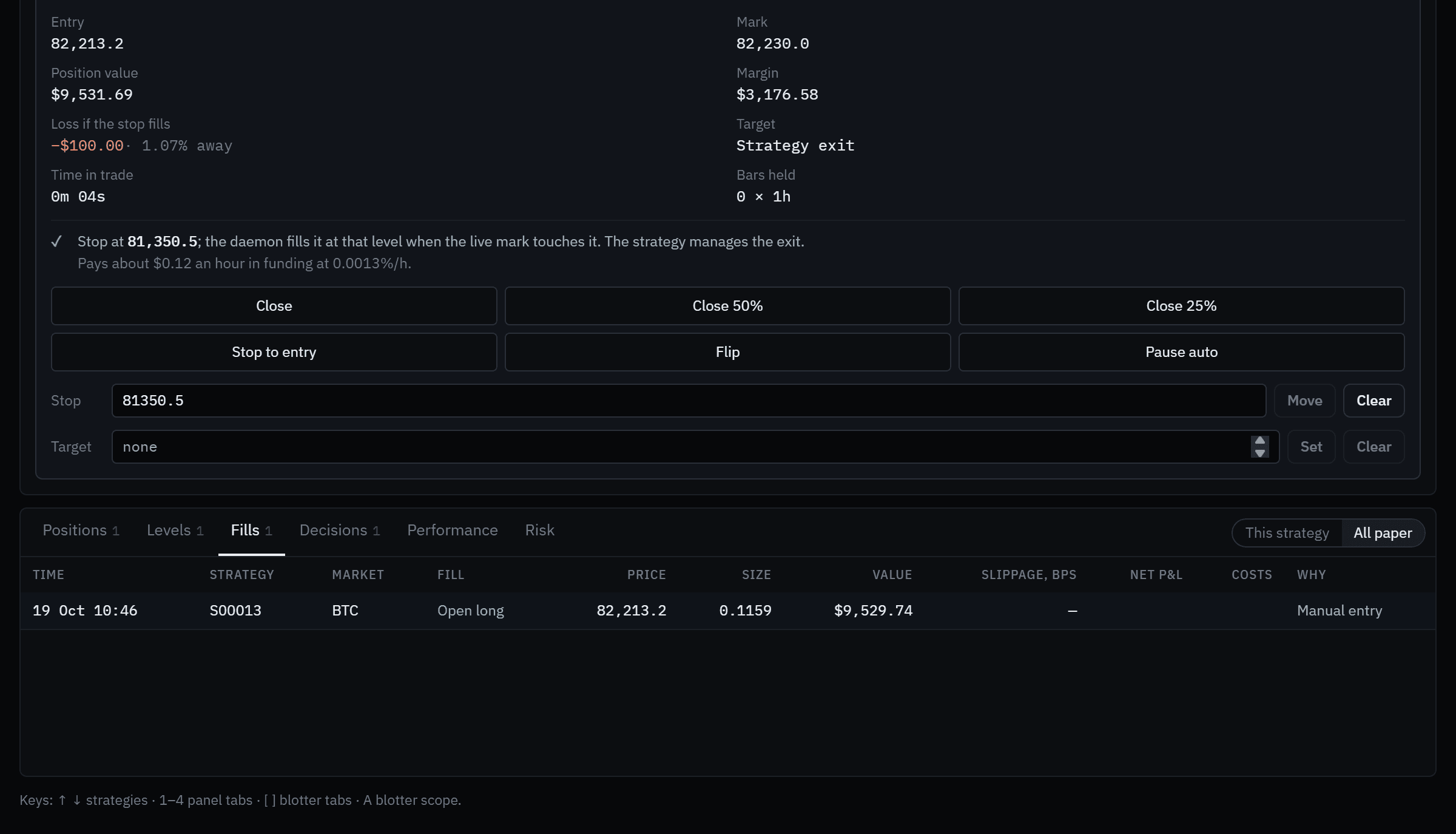 The stop is watched against the live mark; the strategy still manages the exit unless you pause it.
Every action asks for confirmation and lands in the Fills and Decisions blotters.
Let it run
Paper evidence takes time. The paper → live gate waits for at least 30 days and 20 closed trades on paper, then asks whether the forward record backs the backtest — judged against a bar that rises with the number of strategies in paper. Check the Performance tab now and then: the question isn't is it making money? but is it behaving the way its backtest said it would?
If it isn't, Forven doesn't wait for you. A paper strategy is retired automatically when its forward record is clearly losing (15+ trades with a negative average), hits a 15% drawdown, goes 60 days without a trade, or contradicts its backtest. A strategy that does well on a test across 15 coins may also start paper-trading the coins where its rule worked, as one record — see Paper trading.
Paper isn't a prediction
Paper results are a simulation on live data. They don't include the queue position, partial fills or outages of a real exchange, and they don't predict live results. See Paper trading for exactly what is and isn't modeled.
Next
5. Run the gauntlet
Follow a strategy through The Forge — quick screen, then the robustness suite — read its verdict and the checklist for the next gate, and learn why most strategies stop here.
7. Set limits & stop buttons
Learn the three controls that decide what Forven may do on its own — the system mode, the risk limits and Emergency Halt — before you ever need them.