5. Run the gauntlet
Follow a strategy through The Forge — quick screen, then the robustness suite — read its verdict and the checklist for the next gate, and learn why most strategies stop here.
The Forge is the pipeline every strategy moves through: Quick screen → Gauntlet → Paper → Live, with a gate at each step. This guide follows the EMA strategy you sent in Build a strategy: where it is, why it's stuck, how to run the robustness tests yourself, and how to read the verdict.
Before you start
A strategy in The Forge — from the Creator's Send to Forge → or The Forge's Import. About 20 minutes, most of it waiting on tests. No AI key needed.
Let the pipeline drive, or drive it yourself
In Manual mode nothing runs on its own: a strategy you send in waits in quick screen until you run its tests from its page. Switch the top strip to Semi and the pipeline screens, optimizes and tests everything you submit by itself — that's how the strategies in these screenshots moved. Either way the gates are the same.
Open The Forge
Click The Forge in the sidebar. The Pipeline rail shows how many strategies are at each stage right now, how many entered and passed in the last 24 hours, and what's in the Graveyard. Click a column to filter the table to that stage.
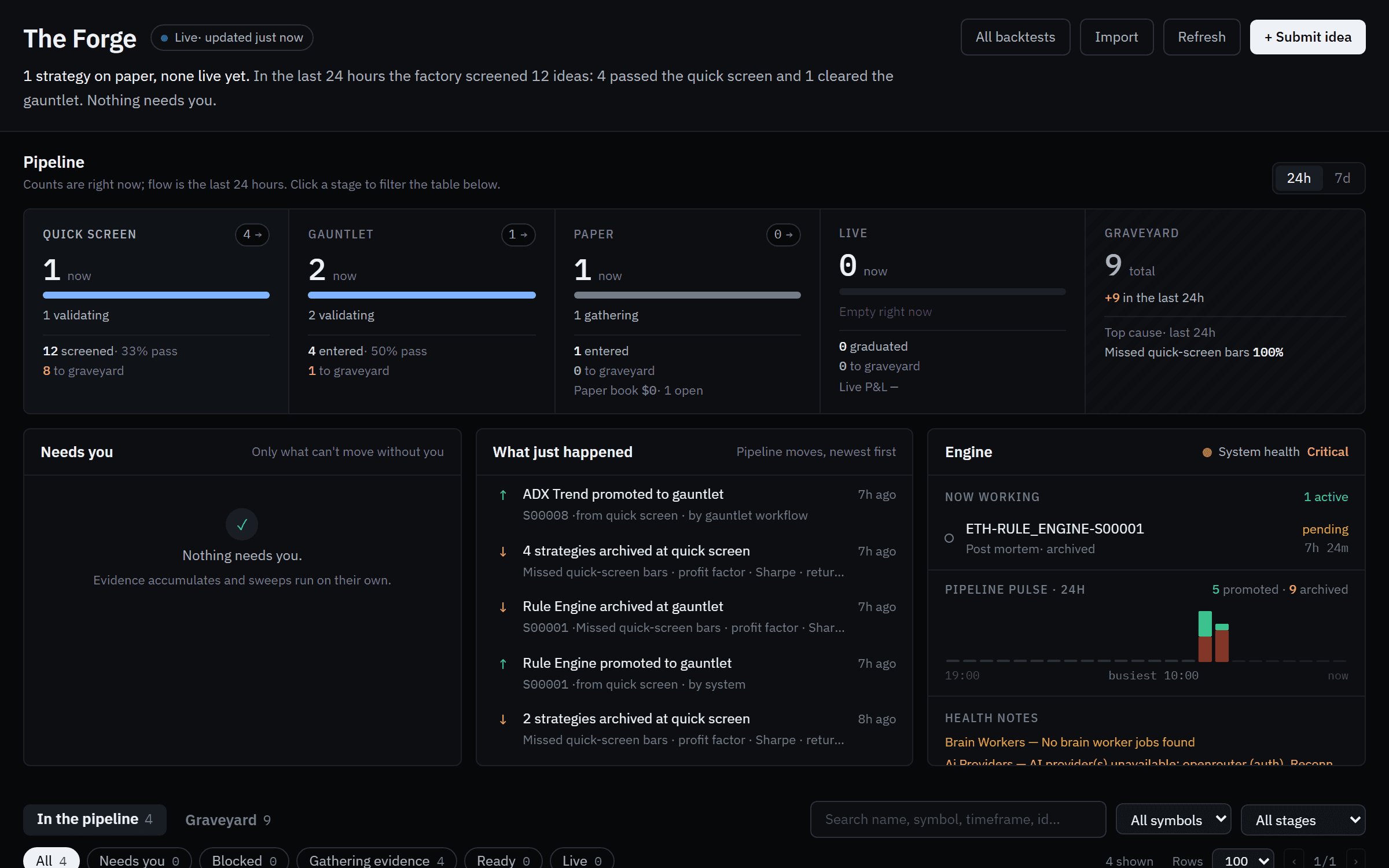 The Forge a few hours after sending in a dozen strategies. Most are already in the graveyard.
Below the rail, three cards answer what needs me?, what just happened? and what is the engine doing?. The table lists every strategy with its stage, a plain-language status, and its out-of-sample numbers — including DSR, the deflated Sharpe.
Open the strategy's page
Click a row to peek at it, then Open strategy page →. The top of the page is the strategy's whole story:
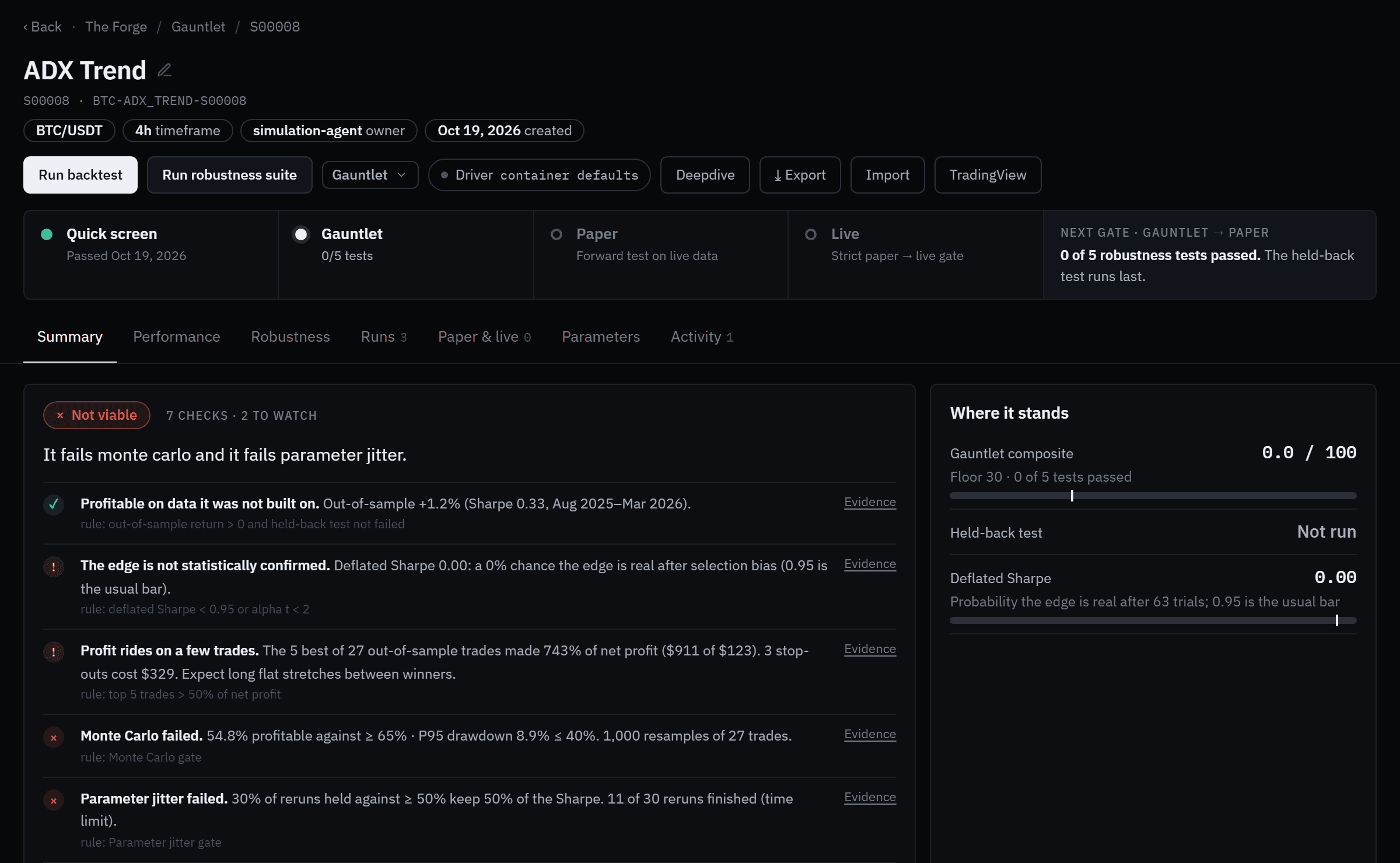 The verdict comes first, with links to the evidence behind each finding.
- The lifecycle rail shows where it is and the next gate it faces.
- The verdict — Viable, Promising · not proven, Not viable or Not enough evidence — with each finding linked to its evidence.
- Where it stands: the gauntlet composite score against its floor of 30, the held-back test, the deflated Sharpe and paper progress. By default the composite and the deflated Sharpe are recorded at the door into paper and enforced before live.
- The evidence ladder puts the same metrics side by side for in-sample, out-of-sample, walk-forward, held-back, paper and live. A real edge survives the move to the right.
This one, ADX Trend, is Not viable. It made a little money out of sample (+1.2%), but five trades carry most of the profit, it fails Monte Carlo and parameter jitter, and a deflated Sharpe of 0.00 after 63 trials says the result can't be told apart from luck.
Read the checklist for the next gate
Scroll down the Summary tab to the gate card. It lists every check for the next stage with the actual value against the requirement, and an action wherever there's something you can run. For a strategy still in quick screen it checks trade count, Sharpe, profit factor, return and drawdown on its own backtest; further along it looks like this — ADX Trend, in the gauntlet, facing the door into paper:
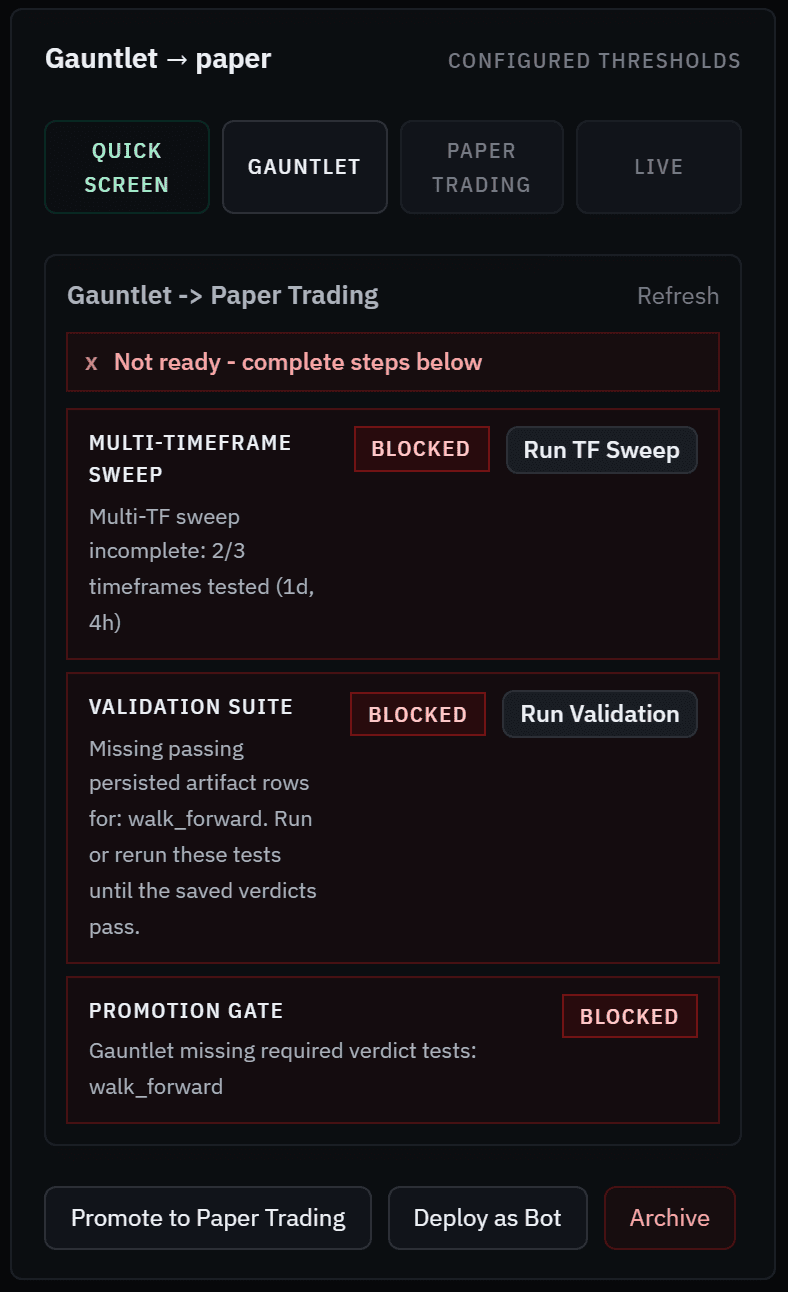 Each blocked row says exactly what's missing and offers the run that would fix it.
Notice what isn't blocking. Under the default research door, the failed Monte Carlo and jitter verdicts and the robustness score of 0 are recorded, not enforced — they're judged again before live. What blocks this card is missing evidence: a walk-forward verdict (that run timed out) and one more timeframe in the sweep.
When every row passes, Promote to Paper Trading moves it on — in Semi or Auto that happens by itself, or the strategy joins the paper queue if the pool is full.
Run the robustness suite
Click Run robustness suite at the top of the page. It opens the Robustness tab at Run a test; click Run Full Suite, or run any test on its own from the Robustness Runners below it. A strategy still in quick screen goes through its quick-screen gate first — our EMA strategy stopped right there, so the screenshots below use one that got further. Five tests run, each asking a harsher question of the same rules. Every one has to run before paper; by default their verdicts are recorded at the door into paper and enforced before live.
| Test | The question |
|---|---|
| Walk-forward | Does it make money in folds of history it wasn't fitted on? |
| Parameter jitter | Does it survive small nudges to its settings? |
| Monte Carlo | Reshuffle the trades — how bad could the drawdown have been? |
| Cost stress | Does it survive doubled fees and slippage? |
| Regime split | Does it only work in one kind of market? |
When they finish, the stress matrix at the top of the tab shows each test's question, result, threshold and verdict. Here is ADX Trend on BTC 4h — a strategy that looked strong out of sample (a Sharpe of 2.7 on 26 trades) before the suite ran:
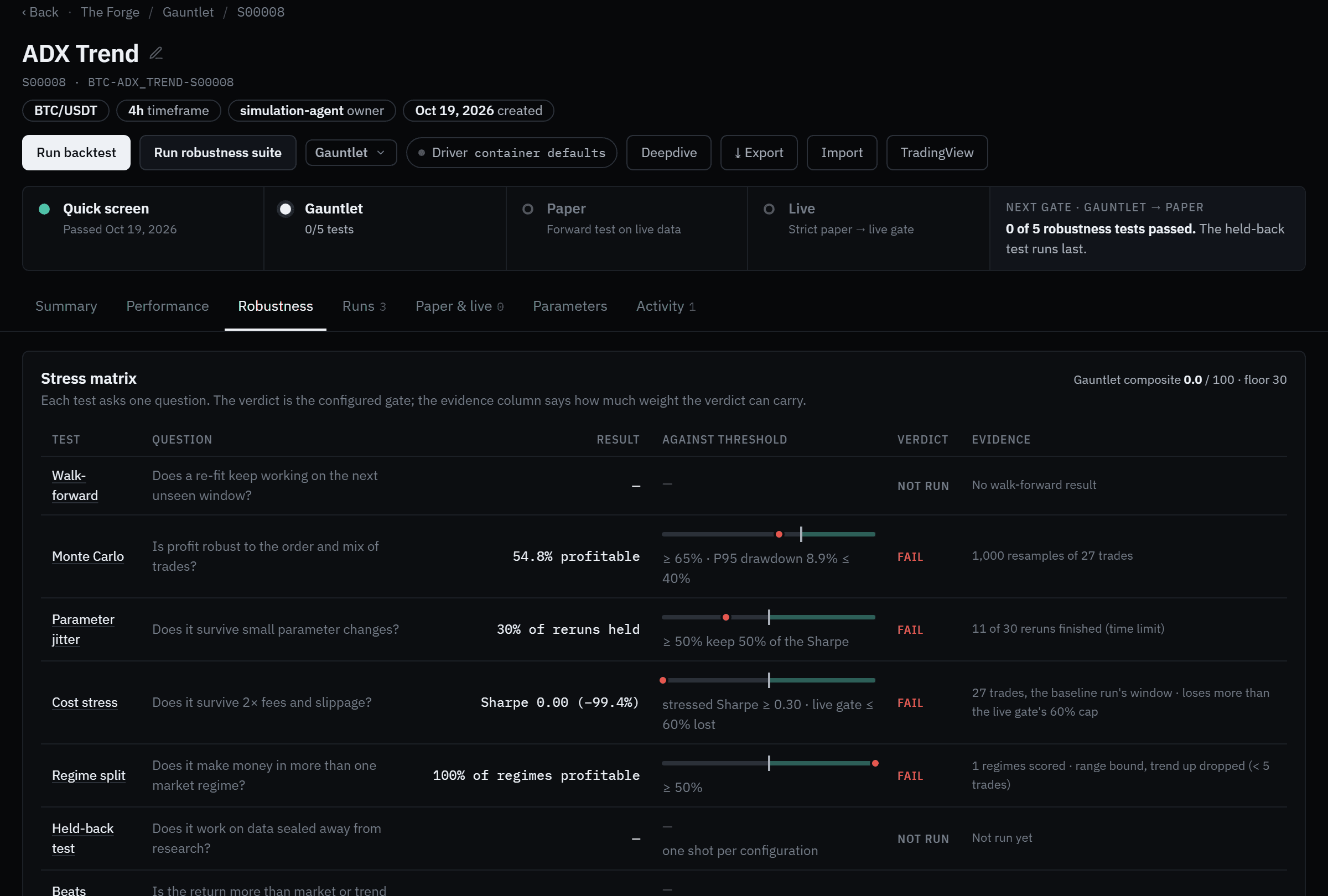 A good-looking out-of-sample number, taken apart: it fails Monte Carlo, jitter, cost stress and regime split.
- Monte Carlo: only 54.8% of 1,000 resampled trade sequences were profitable — the bar is 65%.
- Parameter jitter: most small nudges to its settings lost the edge.
- Cost stress: at twice the fees and slippage, its Sharpe fell to zero.
- Regime split: it only traded enough in one market regime to be scored.
- Walk-forward shows Not run — that run timed out on a busy machine; the page offers to retry it with a shorter window or fewer folds.
Every verdict links to its evidence, and a PASS* on walk-forward means it passed only after fold rescue.
Know what waits until live
Paper risks no capital, so by default the door into paper only stops strategies that are broken or clearly losing: 20+ confirmation trades, a non-negative return, out-of-sample profit factor of at least 1 and Sharpe above 0, drawdown and tail-risk floors, and no loss under 2× costs. The harder checks wait for the step where money is at stake:
- Deflated Sharpe ≥ 0.90. The Sharpe is deflated for every variant that was tried — optimizer trials and sibling strategies — so a lucky best-of-many doesn't pass. Before live it's judged on backtest and paper trades together.
- The held-back test. The most recent 3–6 months — the last full quarter and the current one — are sealed from all research. When the strategy applies for live, it gets one walk-forward run on that data, automatically — and must pass it. It can't be re-run for the same parameters.
- The recorded gauntlet verdicts — walk-forward, jitter, Monte Carlo, cost stress, regime split — and the robustness score.
- Forward evidence. After 20+ paper trades and 30 days, the paper record must back the backtest, against a bar that rises with the number of strategies in paper.
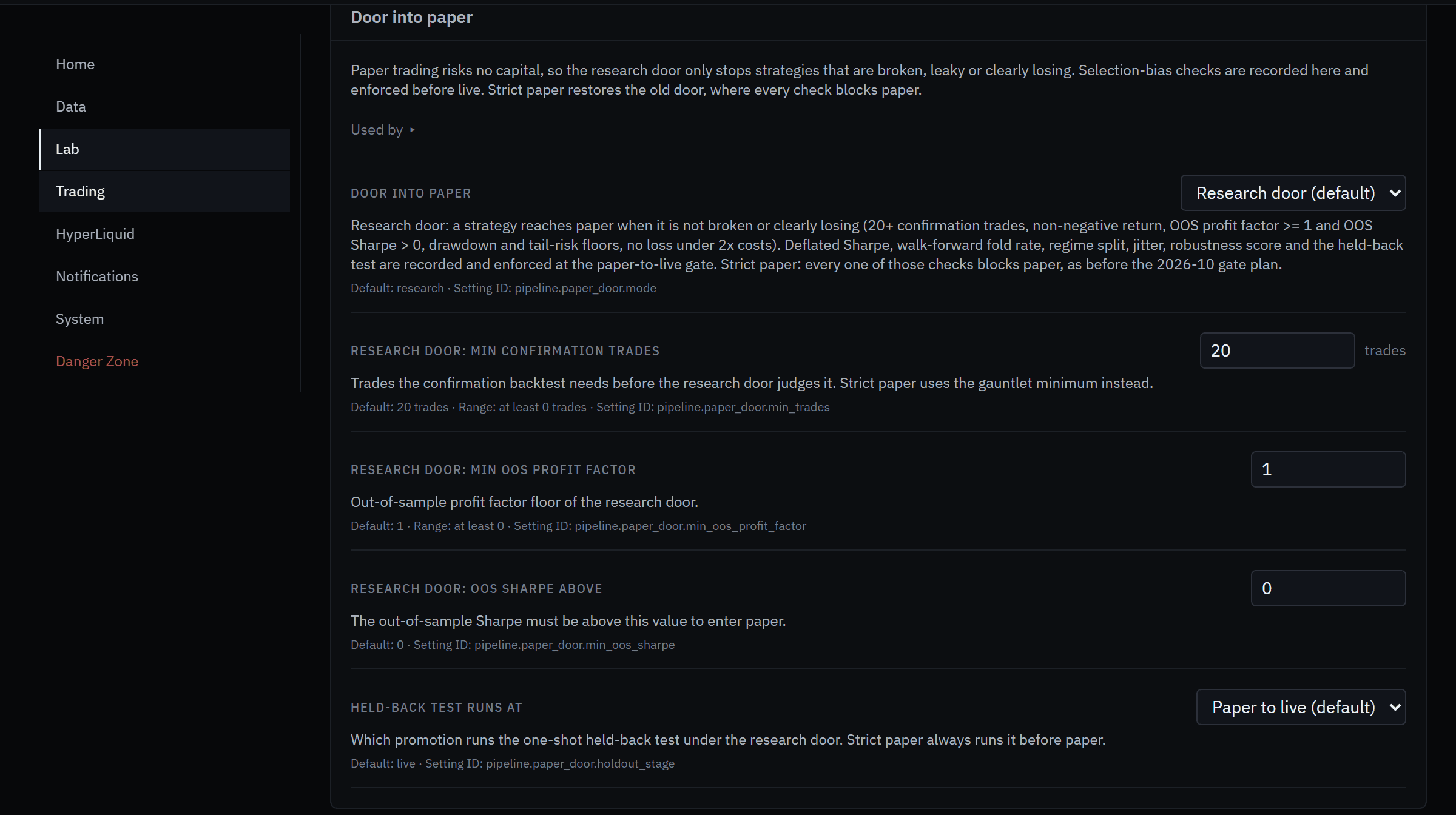 Strict paper puts every one of these checks back in front of paper, as before the October 2026 gate plan.
Once the door is clear, the strategy moves to paper — automatically by default. See Promotion gates for every threshold.
Why most strategies stop here
In the sandbox behind these screenshots, a dozen built-in and hand-built strategies went into the pipeline. Within a few hours, 8 of the 12 screened had been archived at quick screen — losing out of sample or failing its bars — one more died in the gauntlet, two were still being taken apart by it, and one made it to paper. That's the system working. The Graveyard keeps every one with the reason it died, so you can see which ideas failed and why. Paper does the next round of rejecting: a strategy whose forward record turns out to be losing is retired automatically.
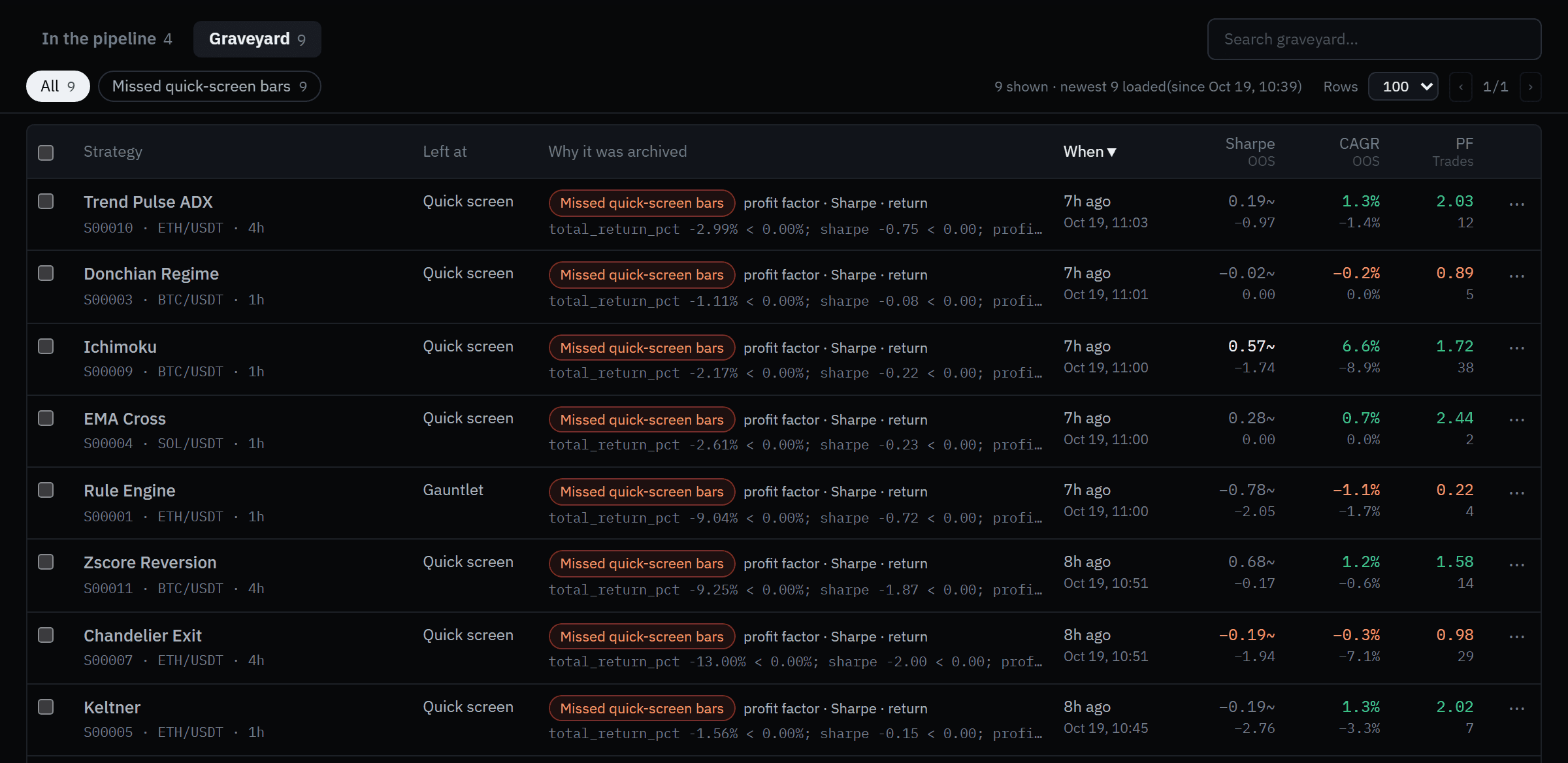 Every archived strategy keeps its reason. Recover from graveyard sends one back to quick screen.
Next
4. Run and read a backtest
Backtest a built-in strategy on any market with Manual Backtest, then read the result the way the gauntlet will — out-of-sample first.
6. Paper-trade a survivor
Watch a strategy trade forward on live market data with simulated fills — read the paper desk, follow its decisions, and open or manage a position by hand.